
Can UI/UX serve as a differentiating moat for your startup?

Let’s get this out of the way: I’m a huge believer in the value of UI/UX, but as I thought through this question, I surprised myself by coming to the conclusion that UI/UX in and of itself is not a sufficient differentiating moat.
Yes, indeed I was surprised!
As product managers, we’re always obsessed with flows, edge cases, etc when we’re writing up product specs. And it’s easy to think that this all translates into UI/UX being incredibly important. But in the grand scheme of things, it would be a mistake to think that UI/UX is always important because… well… it depends.
Why are we even talking about this in the first place?
Despite what you might think, I don’t sit around contemplating various product management questions in my free time. This entire thought exercise came about because I went to a conference where one of the talks touched on how businesses and differentiate to build competitive moats. During Q&A, someone brought up UI/UX, which led to some engaged discussion where some felt that UI/UX wasn’t that important, while others thought it was a critical differentiating moat.
So I went back home and thought that:
This is particularly relevant as a startup product person as you’re constantly trying to figure out what to focus on when resources are limited, and UI/UX is often the first thing to get cut when reducing scope
But on the flip side, not focusing on UI/UX could hurt your chances at finding product-market fit, as cutting too much UI/UX out of MVP scope results in a product that might be super useful, but doesn’t work well
The problem is that the value UI/UX adds differs depending on the situation and is hard to measure. So even if you do want to polish a feature more, it’s hard to convince others to do so.
Before we dig in further on UI/UX, why is it important to think about finding your differentiating moat as a startup?
Well, if you’ve read any of my prior blog posts about working as a startup PM, you’ll notice that I talk a lot about building differentiated value as a startup. Obviously, at a startup, you want to build something DIFFERENT (not necessarily in the product, but throughout the business) that provides MEANINGFUL value to a target MARKET.
Anything that doesn’t serve that purpose isn’t really worth doing early on. So when you’re thinking through whether or not to invest in UI/UX, the question of whether or not it provides or contributes to a differentiating moat is a crucial one.
Thinking about UI/UX as a differentiating moat is the wrong way to prioritize UI/UX
So here’s the thing about UI/UX - the reason why I don’t think it’s a differentiating moat in and of itself, is because WHEN you care about UI/UX is the real question. Unlike some critical factors (like team, execution, market timing), UI/UX isn’t always important.
Now we can’t deny that UI/UX is powerful. Apple and Canva are just some of the big winners in the last decade who have amazing UI/UX. But on the flip side, there are many products that succeed with terrible UI/UX simply because they are solving a huge problem.
Over-prioritizing UI/UX can easily result in a bunch of busy work with no measurable or perceivable value. Think about the age old joke about highly trained engineers at Google changing button colors. You could literally optimize UI/UX for ages - but startups aren’t a game of optimization, but rather a game of disruption.
This doesn’t mean that UI/UX isn’t important - but rather it’s an ingredient towards building a moat, but not the moat itself.
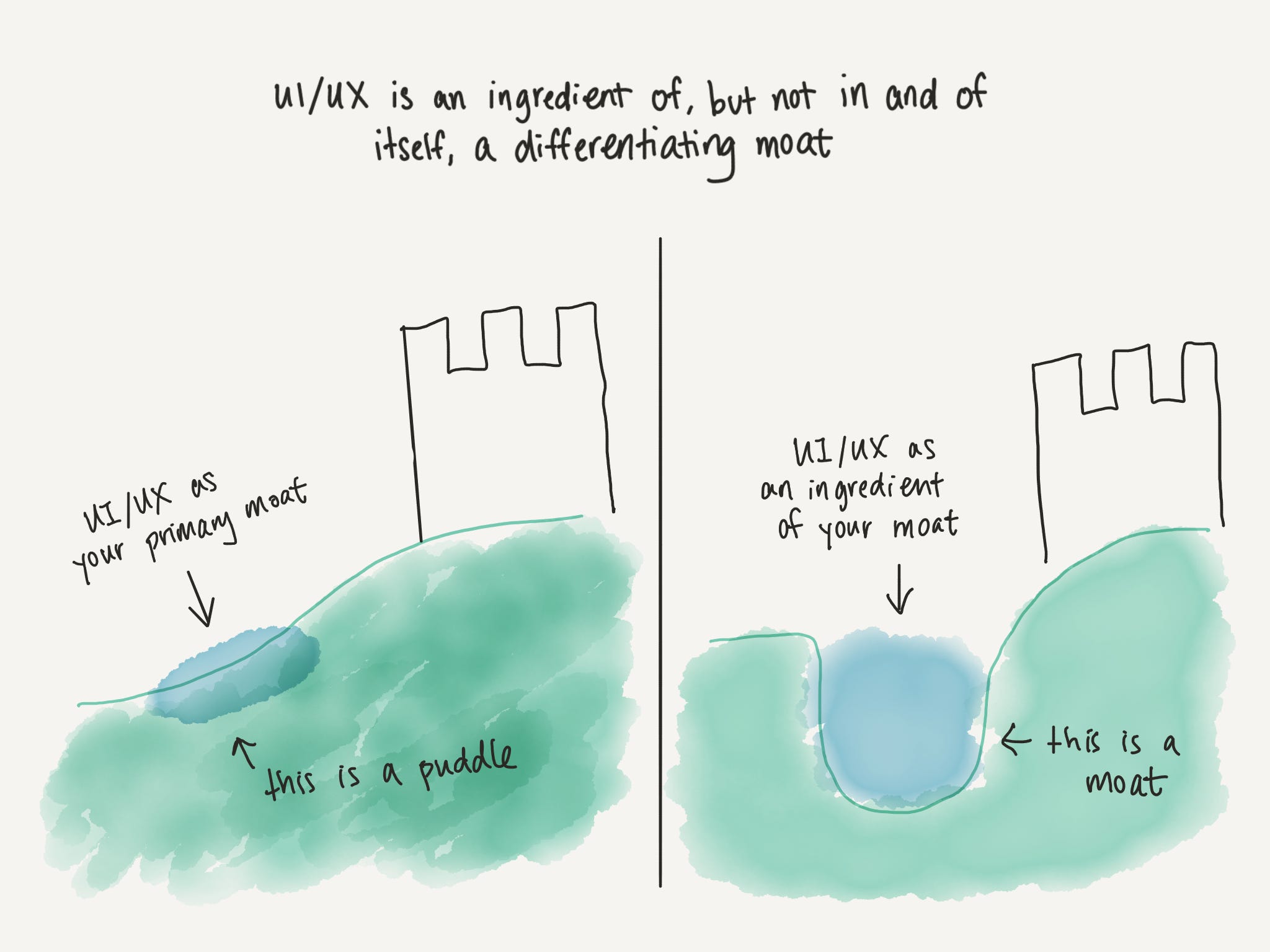
So when should you prioritize UI/UX?
There are a couple cases where I’ve noticed that prioritizing UI/UX is critical towards building a differentiating moat.
Case 1: UI/UX is tied to your value proposition
The product that your building should be significantly (let’s say 10x) better than existing solutions or alternatives. Sometimes, UI/UX is the key to making things better (for example, Scratchpad vs Salesforce). Other times, the alternative is so bad that a poor UI/UX is acceptable. If UI/UX (or ease of use) is what drives people towards your product, then it’s a great idea to over-invest here as a way to drive differentiated value. If spending more time on UI/UX isn’t going to make you 10x better than existing solutions, drop it. Now.
Case 2: UI/UX is impacting distribution and adoption
How customers discover and adopt your product is a competitive moat, and UI/UX can be a critical component here. PLG (product-led growth) is perhaps the best example of this, where a simple onboarding process makes it possible for users to easily adopt the product and share it with their peers. If investing in UI/UX can help you build a competitive moat via distribution and adoption, that’s another great case for spending time here.
Case 3: Poor UI/UX is a symptom of poor execution
This one is a bit surprising and may seem like a curve ball, but it’s worth taking another look at UI/UX if it’s a symptom of a larger cultural issue of poor execution. As I alluded to earlier, UI/UX is often the first to go when it comes to scoping an MVP, but seen another way, scoping out polish too often results in a subpar end product and a culture of “un-excellence.”
If your UI/UX is starting to make you feel like it’s hampering your customer’s ability to use your product or impacting their opinion of your brand, it’s worth taking another look before the entire team starts to think that UI/UX isn’t a priority.
Don’t disregard how important UI/UX is
It is incredibly dangerous to disregard the importance of UI/UX. In Case 1, you might be missing a critical value prop that is crucial to your users. In Case 2, you might be hurting your ability to compete with others when it comes to conquering the market. In Case 3, you might be creating a culture where poor execution is explained away as planned scope reduction. But remember, at different times in your company journey, the importance of UI/UX will be different.
Now one final thing I’d like to note is that the importance of UI/UX isn’t really dependent on industry, but more so on the three cases outlined above. If you’re working on infrastructure, it’s easy to think that UI/UX isn’t as important as most developers interact with your UI. This is patently false - your APIs and terminal interface are UI/UX too.
At the end of the day, everything is about providing value for users, getting your product in front of the right users, and out-executing your competitors. UI/UX can play a critical part in winning depending on where you are in your startup lifecycle. Ignore it (or over-weight it) at your own peril!